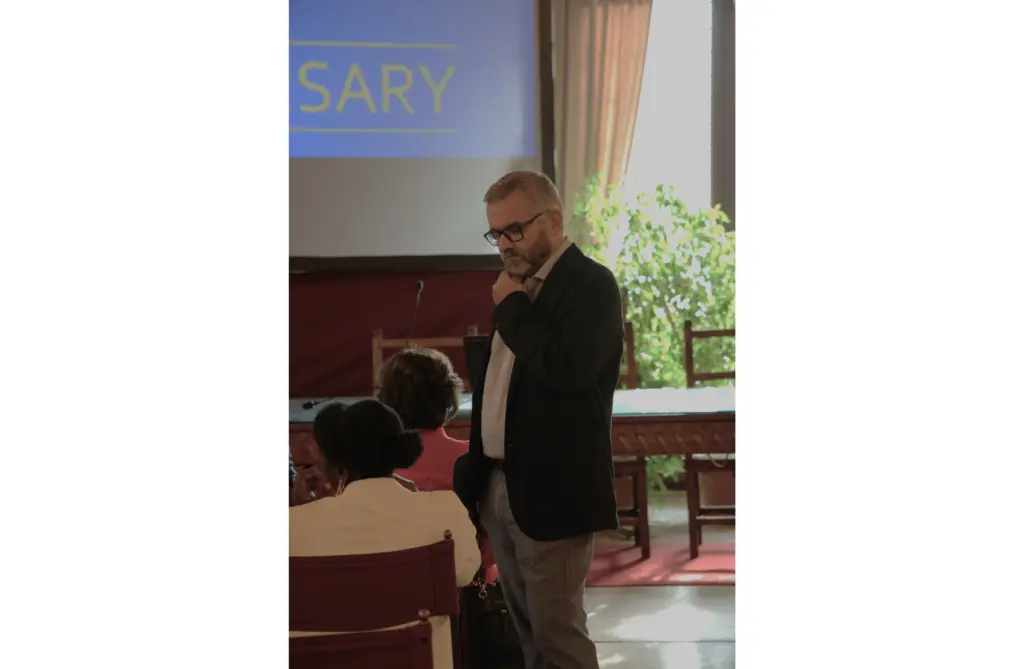
The Venice programme recognised the partnership with Andrea Bernini and the doctorate in Biochemistry and Molecular Biology, connecting MAGI’s academic origins with its continuing scientific work
The relationship between the University of Siena and MAGI linked a shared scientific history with a defined educational pathway: the PhD in Biochemistry and Molecular Biology, BiBiM 2.0. Professor Andrea Bernini’s contribution to MAGI’s twentieth anniversary examined that connection through molecular research and the preparation of younger scientists. The congress, held on 9 October 2026 at the Scuola Grande di San Marco in Venice, placed the partnership within six scientific sessions and a programme involving institutions in eight countries.
Siena occupied a distinctive position because MAGI’s founding initiative in 2006 had emerged from a scientific experience in the university’s doctoral environment. Subsequent development brought together the main laboratory in Rovereto, MAGI EUREGIO’s bioinformatics work in Bolzano and data science in San Felice del Benaco. MAGI Balkan in Albania and MAGISNAT in the United States extended the group’s activities, while the Siena relationship retained its focus on biochemical understanding and advanced research training.
Venice as a Place of Scientific Exchange
The setting gave the occasion a historical and civic context. The Scuola Grande di San Marco, associated with Venice’s hospital complex and Museum of Medicine, connected the discussion of contemporary research with a longer history of public service and the transmission of knowledge. The programme included a museum visit, bringing the scientific meeting into direct contact with the medical heritage of its host institution.
Venice also provided a geographical connection with the group’s roots in Rovereto and Bolzano. The Triveneto comprised their region, Trentino-Alto Adige/Südtirol, together with Veneto and Friuli-Venezia Giulia. The city’s international recognition gave the meeting an appropriate setting for colleagues working in different academic systems. For Siena and MAGI, the occasion was an opportunity to consider how a relationship originating in doctoral research had acquired continuity through laboratory work, supervision and shared scientific questions.
The opening programme included a welcome from Mario Po’ and an introduction by neurologist Lorenzo Lorusso to the Scuola as a forum for scientific exchange and dialogue. This framing was pertinent to the Siena partnership: a relationship in which the continuing circulation of questions, methods and expertise had remained central to the scientific undertaking.
A Doctoral Relationship with a Defined Academic Basis
Professor Bernini’s contribution was included in the session on international research partnerships and doctoral training, alongside the presentation of the biotechnology relationship with Trnava by Professor Stanislav Miertuš. The Siena presentation concerned doctoral education and research in biochemistry and molecular biology. Its position in the programme placed the development of researchers within the same discussion as the scientific collaborations through which their work acquired direction.
BiBiM 2.0 brought together biochemistry, molecular biology, bioinformatics, structural and cellular biology, and genomics. The university described its educational scope as spanning academic institutions, public and private research organisations, and industry. The agreement supporting MAGI’s involvement in doctoral training therefore connected the group with a programme whose disciplinary breadth was relevant to its laboratory and analytical activities.
A previous official Siena doctoral call had included a position reserved for an employee of MAGI EUREGIO. This gave the educational relationship a documented connection with the Bolzano organisation. Within the anniversary account, that record illustrated how research training had connected university supervision with work in a laboratory network. It also placed the development of individual researchers at the centre of the partnership: their preparation, scientific independence and capacity to bring methods learned in one setting into constructive discussion with colleagues in another.
From Molecular Measurements to Biological Explanation
Bernini’s research background included structural biochemistry, nuclear magnetic resonance, computational methods and metabolomics. These fields were relevant to a recurring question in molecular research: how an observation made in a biological sample could be related to the behaviour of the molecules involved. Addressing that question required a connection between measurement, structural interpretation and a testable account of biological function.
For MAGI, the significance of this approach lay in the integration of omics information. Within this framework, genomics examined DNA variation; proteomics studied proteins; metabolomics investigated small molecules associated with biological processes. Microbiomics added information about microbial communities. Each described a different aspect of a biological system, and the value of combining them depended on the quality of both the measurements and the question that guided their comparison.
A genetic change affecting a protein, for example, could raise questions about its stability, molecular interactions or activity. Structural analysis could help identify which consequences were plausible and which experiments might discriminate between them. A computational model remained a hypothesis to be assessed against other evidence. Its contribution was to make the next research question more precise and to help interpret the observations that followed.
Metabolomic work added another perspective by examining biochemical patterns in a sample. Those patterns needed to be considered in relation to sampling conditions, biological variation and the wider experimental design. The intellectual connection with Siena lay in bringing such measurements into a molecular explanation, with the aim of understanding why a pattern occurred and how it related to the system under investigation.
Education Within an International Scientific Conversation
The wider congress programme reinforced the importance of quantitative interpretation. Professor Peter J. van der Spek’s contribution concerned clinical bioinformatics and multi-omics integration, while Professor Eglantina Kalluçi’s presentation addressed mathematical sciences and interdisciplinary research in the partnership with Tirana. These subjects provided a broader context for the molecular and computational expertise associated with the Siena relationship.
For doctoral researchers, this meant learning to connect a biological hypothesis with a transparent analytical workflow. The choice of samples, the handling of variation and the interpretation of statistical comparisons all influenced what a study could establish. Training across molecular science and computation helped researchers examine those decisions and communicate their significance to colleagues from other disciplines.
The anniversary thus placed doctoral training within a continuing scientific conversation. For MAGI, the relationship with Siena connected its founding academic experience with the preparation of researchers able to design studies, evaluate evidence and work across disciplinary boundaries. In Venice, that continuity was represented through a programme that gave university cooperation an explicit place in the group’s account of twenty years of research.


More Stories
The Age of Personal AI Agents: Why the Next AI Revolution Will Change the Way We Work
The People Behind the Paperwork: Welcome Israel on Who Pursues Israeli Citizenship by Descent
Music Fades, Kindness Endures: London Charity Concert Ends in Success, 15-Year-Old Shirley Lights the Way for Girls’ Education Through Music